Project 01, started 2023
Hexapod Robot
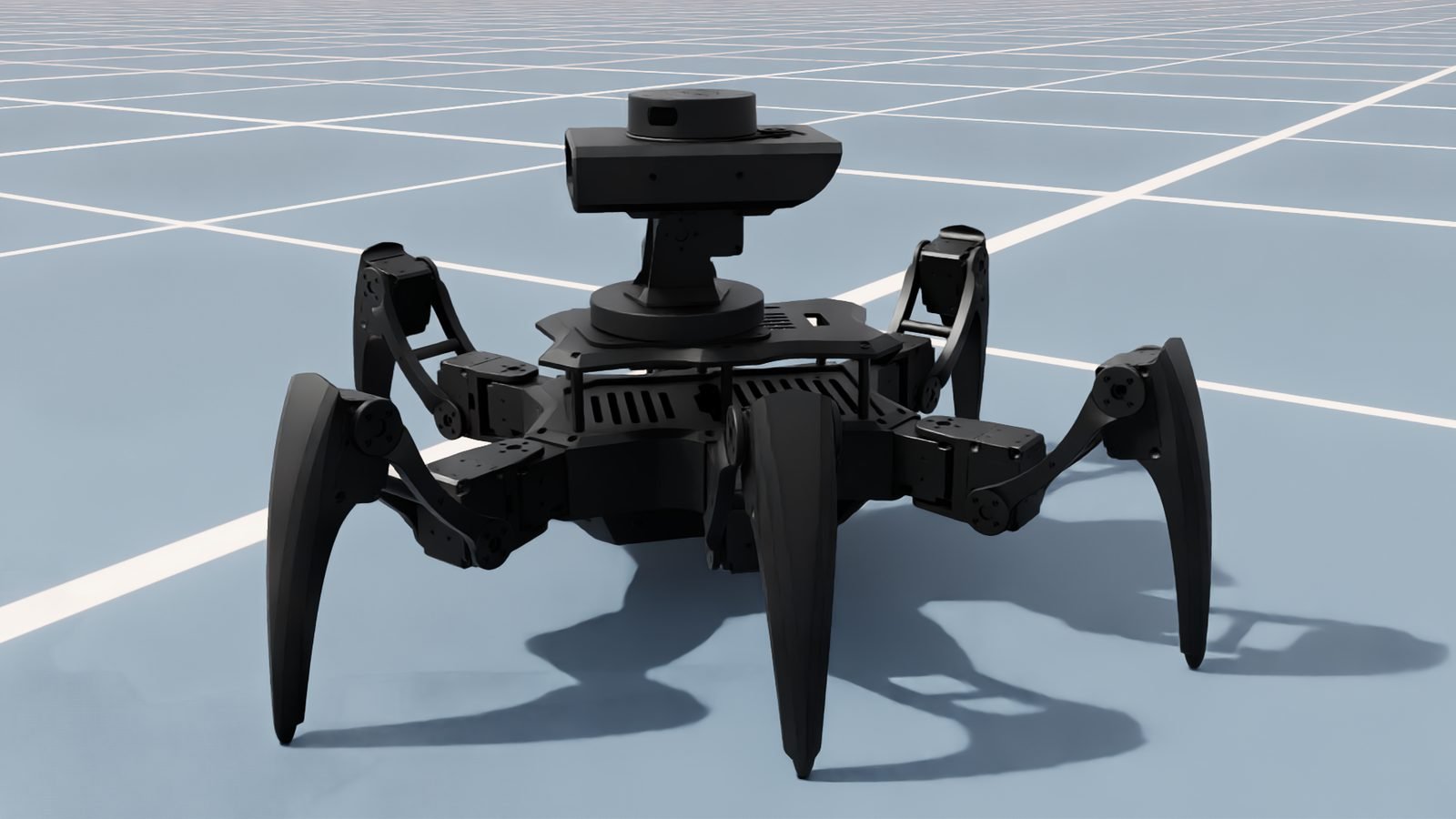
A six-legged robot designed and built from scratch: the mechanics, the electronics and every layer of software, from the leg kinematics up to navigation, voice control and reinforcement learning.
- Mass
- ≈ 3.3 kg
- Legs
- 6 × 3 joints: coxa 37.5 mm, femur 100 mm, tibia 149 mm
- Actuators
- 20 × Dynamixel XL430-W250 (18 in the legs, 2 in a pan-tilt head)
- Sensors
- Intel RealSense D435i (depth, colour, IMU), RPLIDAR 2D lidar, 6-channel microphone array
- Middleware
- ROS 2 with ros2_control, Nav2, slam_toolbox, robot_localization
- Simulation
- Gazebo, NVIDIA Isaac Sim, Isaac Lab
- Computer
- NVIDIA Jetson Orin Nano, ROS 2 Humble (originally a Jetson Nano)
- Power
- 3S LiPo, 11.1 V, 5200 mAh, with a custom servo power hub
Why a hexapod
Six legs make a robot that can always keep three feet on the ground, so it stays stable even when it walks slowly or stops mid-step. That makes it a forgiving platform for trying things out, from a hand-written gait to learned controllers. It also raises questions that wheeled robots don't have: how to estimate where you are from your own footsteps, and what to do when one of your legs stops working.
The project grew in layers. Each one is written up on its own page:
-
01
Design & build
The mechanical design, the sensor head, the battery and power system, a custom power hub PCB for the servos, and the Jetson that runs it all.
-
02
Gait & kinematics
The leg geometry, the inverse-kinematics equations, the foot trajectory, and how a ROS 2 node turns a velocity command into twenty servo positions.
-
03
Autonomy
Estimating position from leg kinematics and the IMU, mapping with lidar SLAM, navigating with Nav2, and adding object detection and voice commands.
-
04
Learning to walk
Training locomotion policies with PPO in Isaac Lab: shaping a tripod gait without imposing one, and a damage-aware policy that keeps walking on five legs.
Where it stands
The real robot walks with the hand-written gait. Localisation, mapping, navigation, vision and voice were developed and tested on its digital twin in Gazebo and Isaac Sim, through the same ROS 2 interfaces the hardware uses. The learned policies so far run in simulation only. Moving them to the real robot means first measuring the real servo parameters and removing the observations that only a simulator can provide.